
 Katharina Frohne
Historical Biodiversity Dataset Receives FAIRest Dataset Award 2026
A dataset of animal observations from 1845 has been honored with the 2026 Thuringian FAIRest Dataset Award. The award highlights how NFDI4Biodiversity, together with archives, universities, and other research institutions, transforms historical biodiversity records into valuable resources for scientific research.
Recognition for Exemplary Research Data Preparation
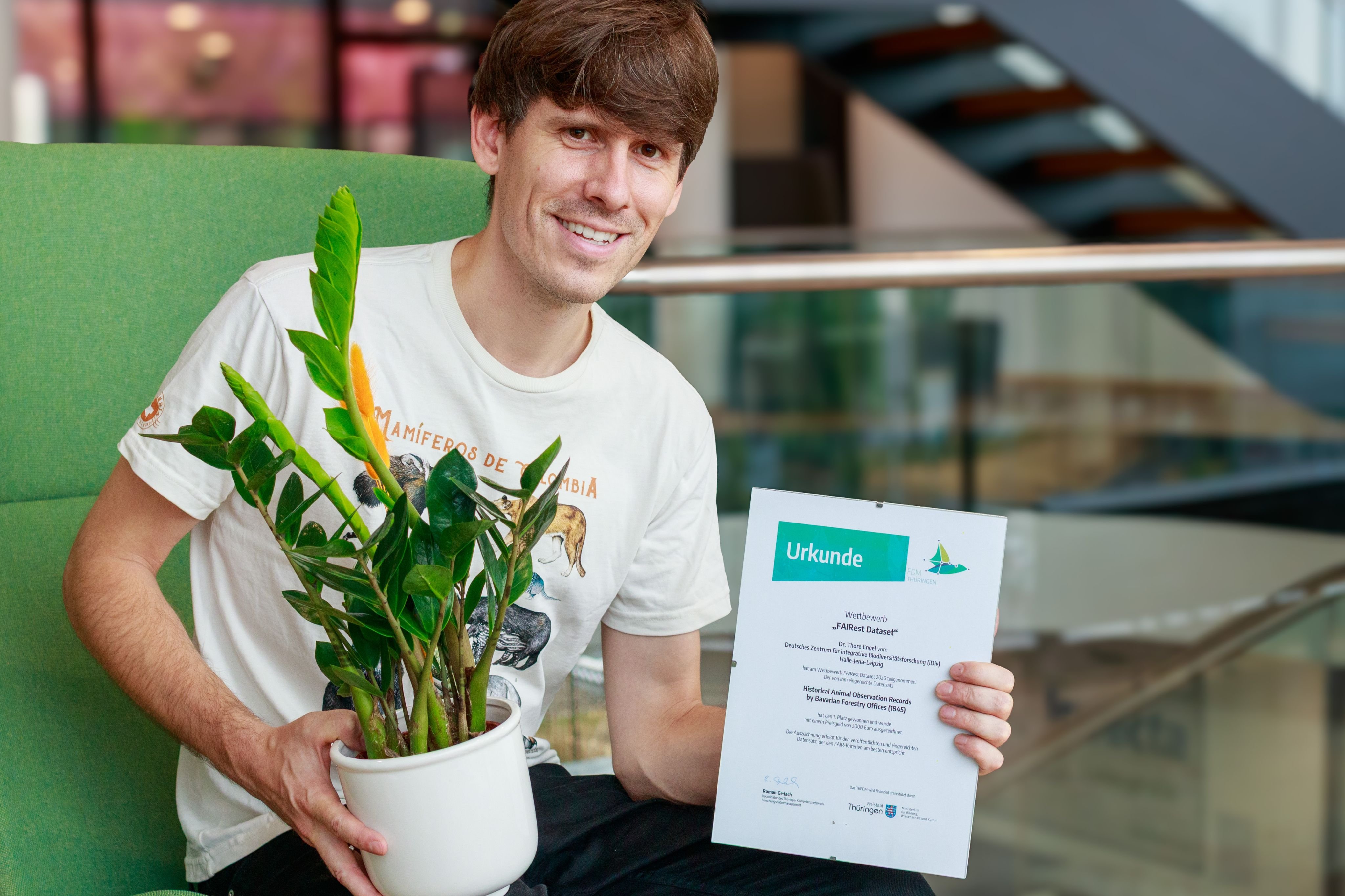
The dataset Historical Animal Observation Records by Bavarian Forestry Offices (1845) has been honoured with the Thuringian FAIRest Dataset Award 2026. Presented by the Thuringian Competence Network for Research Data Management, the award recognises datasets that demonstrate exemplary implementation of the FAIR principles: Findable, Accessible, Interoperable, and Reusable.
The jury particularly praised the dataset’s comprehensive documentation, consistent use of established standards, and high potential for reuse. Dr Thore Engel from the German Centre for Integrative Biodiversity Research (iDiv) accepted the award on behalf of the entire team of authors and project partners.
For NFDI4Biodiversity, the €2,000 award is a special recognition. The winning dataset was mobilised during the consortium’s first funding phase and exemplifies its mission to make biodiversity data from a wide range of sources sustainably findable, interoperable, and reusable.
From archival records to research data
The award-winning dataset is based on a Bavaria-wide survey conducted in 1845. At that time, foresters across the region recorded handwritten observations of animal species, including wolves, lynx, brown bears, and Eurasian otters. For decades, these unique historical records remained in the Bavarian Main State Archives and were effectively inaccessible for biodiversity research.
Only through the collaboration of experts from the Bavarian State Archives, the University of Passau, the German Centre for Integrative Biodiversity Research (iDiv), the Berlin Botanical Garden and Botanical Museum (BGBM), the Helmholtz Centre for Environmental Research (UFZ), the Research Institute for Farm Animal Biology (FBN), and Friedrich Schiller University Jena was it possible to digitize, georeference, taxonomically harmonize, and prepare these historical records in accordance with international biodiversity standards. The resulting dataset was then published via GFBio and the Global Biodiversity Information Facility (GBIF), making it openly accessible to researchers and conservation practitioners worldwide.
Today, the dataset not only serves as a valuable resource for studies on long-term biodiversity change, but also demonstrates how historical archival sources can be systematically integrated into modern research infrastructures.
"This award is especially meaningful to us because it demonstrates that high-quality research data management truly makes a difference."
The award also highlights one of NFDI4Biodiversity’s key strengths. As a nationwide consortium, it brings together archives, universities, research institutes, natural history societies, citizen science initiatives, and data infrastructures to prepare biodiversity data from highly diverse sources according to shared standards and make it sustainably available for research and nature conservation.
"This award is especially meaningful to us because it demonstrates that high-quality research data management truly makes a difference," says Prof. Dr Frank Oliver Glöckner, spokesperson for NFDI4Biodiversity. Dr Barbara Ebert, Deputy Spokesperson of the consortium, adds: "Beyond that, the award recognises a form of collaboration that lies at the heart of NFDI4Biodiversity. As a network of experts, we bring together people and institutions with very different perspectives and areas of expertise. When these complementary strengths come together, they create solutions and datasets that go far beyond what any single institution could achieve on its own. Seeing such a collaborative effort recognised is a wonderful affirmation of the path we are pursuing as a consortium."
The project brought together several institutions that are part of the approximately 60-member NFDI4Biodiversity network, including the Bavarian Main State Archives, the University of Passau, iDiv, UFZ, BGBM, FBN, and Friedrich Schiller University Jena.
The mobilization of the Bavarian archival data exemplifies the consortium's mission. Since 2020, NFDI4Biodiversity has curated and published more than 1,700 biodiversity datasets as FAIR data. In addition, numerous dynamic datasets from natural history collections—comprising millions of species occurrence records—have been made openly available through international infrastructures such as GBIF, enabling new opportunities for biodiversity research.
Further information about the award, the winning team, and the jury’s rationale can be found in the press release of the Thuringian Competence Network for Research Data Management.
About the FAIRest Dataset Award
Since 2020, the Thuringian FAIRest Dataset Award has been presented by the Thuringian Competence Network for Research Data Management. It recognises published research datasets that exemplify best practice in implementing the FAIR principles. According to the network, the competition is the longest-running FAIR award in the German research landscape, and the 2026 edition marked its seventh call for submissions. The award aims to raise the visibility of high-quality research data management and encourage the publication of well-documented, reusable research datasets.
Further info on this topic
- Dataset in GBIF
- Dataset in the Living Atlas of Nature Germany (LAND)
- Data publication on Zenodo
- Digitised archival records in the finding aids database of the Bavarian State Archives
- How archival data inspire new research, NFDI4Biodiversity News Blog, May 2025: https://www.nfdi4biodiversity.org/en/news/archival-data-inspires-new-research/
- Remarkable data treasure: 180-year-old data collection mobilized for biodiversity research, NFDI4Biodiversity-Newsblog, Dezember 2024: https://www.nfdi4biodiversity.org/en/news/historische-biodiversitaetsdaten-mobilisiert/



News
From Volunteer Fish Observations to an Internation...
A Long-Term Future for NFDI: Transition to Permane...
BIIGLE4Beginners: A New Online Tutorial for Image ...
Open Data, Shared Responsibility: New Guidance Sho...

Historical Biodiversity Dataset Receives FAIRest D...

CloWM Joins the NFDI4Biodiversity Service Catalog ...
From Three to Six: Biodata Interest Group Publishe...
"Creating knowledge without data is impossible"

NFDI4Biodiversity Flexfunds: Three Projects Show H...